Business Units
When separating is the smartest decision

This article is an excerpt from the book “Digital Transformation and Product Culture: How to Put Technology at the Center of Your Company’s Strategy”.
In some situations, instead of having separate product teams within the same organization, it might be interesting to create reasonably independent business units. In business units, we have not only a separate product development team but also all the necessary areas for the business to operate independently, such as marketing, sales, customer service, etc.
At Locaweb, we opted for the independent business unit model when acquiring companies. Tray was a company whose e- commerce solutions became part of Locaweb’s product portfolio. As Tray already operated as an independent company, we chose to maintain it that way, only having administration, finance, and HR areas in common. This is a common way to create business areas through company acquisitions.
At Gympass, we envisioned the opportunity to create a new product called Gympass Wellness, offering wellness services such as fitness, nutrition, and meditation apps for Gympass clients’ employees. We chose to start this new product as a business unit, with an independent product, marketing, and sales team from Gympass, aiming to provide greater autonomy and agility to this team.
CrediPronto is a business unit of Lopes, a joint venture between Lopes and Itaú to offer credit to real estate buyers. Due to the nature of the business being completely different from the main real estate transaction business and having a new partner, the business unit model was chosen.
The use of business units can also make sense when product development teams become very large. Product tribes can evolve into business units, maintaining a set of structural tribes that help create consistency among the different teams in the business units.
This is the model used by Itaú, with its integrated communities and technology enabler communities:
Integrated communities: deliver business-oriented solutions, such as credit card communities, consortium communities, insurance communities, investment solution communities, and so on.
Technology enabler communities: build technical tools and products so that integrated communities focus on developing solutions and digital products for the bank’s customers, instead of having to worry about these more technical foundations. Here, for example, are the communities that enable, streamline, and accelerate the use of public cloud, APIs, CI/CD, design systems, agile digital product management, among others.
iFood also uses a similar model with three business units: food delivery, groceries, and fintech, with structural teams focusing on what is common to these three business units.
Digital transformation and product culture
This article is another excerpt from my newest book “Digital transformation and product culture: How to put technology at the center of your company’s strategy“, which I will also make available here on the blog. So far, I have already published here:
Part 1: Concepts
Chapter 1: The so-called digital transformation – Project and Product
Chapter 2: Uncertainty and digital transformation
Chapter 3: Types of company
Chapter 4: Type of company vs digital maturity
Chapter 5: Business models
Chapter 6: Agile, digital and product culture
Part 2: Principles
Chapter 7: Deliver early and often – Measuring and managing the productivity – Case study: Dasa Group – Case study: Itaú Unibanco
Chapter 8: Focus on the problem – The Famous Product Discovery – Why the “business demands => IT implements” model does not work – Case study: Magazine Luiza
Chapter 9: Result delivery – Outsource or internal team? – Case study: Centauro
Chapter 10: Ecosystem mindset
Part 3: Tools
Chapter 11: Product Vision – Product vision examples
Chapter 12: Product Strategy
Chapter 13: Team Structure – Structuring effective product development teams – Structural teams – Team structure spreadsheet – Downsizing and layoffs – CTO + CPO – Internationalization – Outsourced team – Tuckman model – Dependencies between teams – Should we have a dedicated innovation team? – Should we have a team dedicated to fixing bugs? – Business Units
Scale your customer research
In a world where AI levels the playing field, deep customer knowledge is the one asset your competitors can’t copy. ReveLumi was built exactly for that. Learn more at revelumi.com.
Workshops, coaching, and advisory services
I’ve been helping companies and their leaders (CPOs, heads of product, CTOs, CEOs, tech founders, and heads of digital transformation) bridge the gap between business and technology through workshops, coaching, and advisory services on product management and digital transformation.
Gyaco Podcasts
At Gyaco, we believe in the power of conversations to spark reflection and learning. That’s why we have “Product in Focus” (Produto em Pauta in Portuguese), a podcast that explores the world of product management from different angles:
Mentoring Sessions: In this series, I share real mentoring conversations with product people. One person’s questions are often the questions of many. Together, we explore concrete challenges and turn experience into practical insights you can apply to your own context.
Beyond the Buzzwords: In this series, Felipe Castro and I demystify product terms with real examples from our clients.
Available on YouTube and Spotify. Recorded in Portuguese, with English subtitles on YouTube.
Digital Product Management Books
Do you work with digital products? Do you want to know more about managing a digital product to increase its chances of success, solve its user’s problems, and achieve the company objectives? Check out my Digital Product Management books, where I share what I learned during my 30+ years of experience in creating and managing digital products:
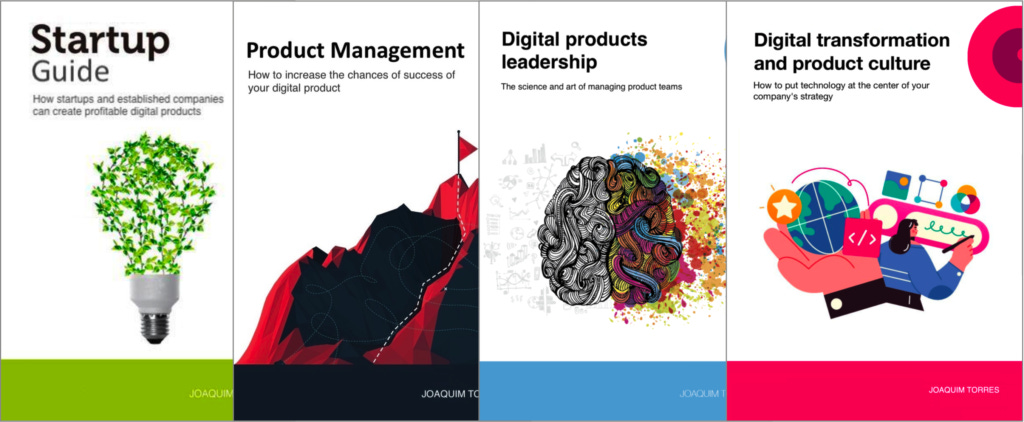
Digital transformation and product culture: How to put technology at the center of your company’s strategy
Leading Product Development: The art and science of managing product teams
Product Management: How to increase the chances of success of your digital product
Startup Guide: How startups and established companies can create profitable digital products