Dependencies between teams
How team dependencies reveal your product culture maturity

This article is an excerpt from the book “Digital Transformation and Product Culture: How to Put Technology at the Center of Your Company’s Strategy”.
When organizing teams into tribes and squads, including product teams and structural teams, it’s common to encounter dependencies between teams. For instance, one team may need another team to implement something in their part of the product to achieve a specific goal. These dependencies can lead to bottlenecks in the product development process and delays in achieving results and objectives.
There are three ways to handle dependencies between teams:
Requesting prioritization: The simplest approach is to ask the other team to prioritize the task. If the team doesn’t prioritize it, there’s always the option to escalate the need, and the area leader can make a top-down prioritization. This is the least preferable way to handle dependencies since the priorities of one team are rarely the same as those of another. Escalating the need and prioritization can lead to relationship difficulties between teams.
APIs (Application Programming Interfaces): In this model, all teams build not only their functionalities but also APIs for internal consumption of these functionalities. It’s a good strategy that allows minimizing dependencies between teams and, eventually, offering these APIs for external consump- tion. However, there is a risk that something new has not yet been implemented and needs to enter the team’s prioritization.
Innersource: This involves using best practices from open- source software development and establishing a culture sim- ilar to open source within organizations for developing their proprietary software. It is the best solution for dependencies between teams but requires maturity. In this dependency model, when team A needs something to be implemented in the code of another team B, members of team A make the necessary modification in team B’s code and submit it for team B to review. If everything is okay, the modification is published.
It’s important to note that innersource is not just a technical practice, but also a direct reflection of an organization’s culture. It requires a higher level of trust between teams, clear standards for code quality, mature review processes, and a shared-ownership mindset. Without these elements, attempts to adopt innersource are likely to create more friction than benefits.
Since my time at Locaweb, I’ve been intentionally working with the innersource model to help reduce cross-team dependencies.
In organizations going through digital transformation, how cross-team dependencies are handled becomes a strong indicator of product culture maturity. The more a company relies on escalations and top-down prioritization, the slower and more fragile its execution tends to be. On the other hand, models that increase autonomy and reduce structural bottlenecks typically translate into higher speed, better alignment, and stronger business outcomes.
Digital transformation and product culture
This article is another excerpt from my newest book “Digital transformation and product culture: How to put technology at the center of your company’s strategy“, which I will also make available here on the blog. So far, I have already published here:
Part 1: Concepts
Chapter 1: The so-called digital transformation – Project and Product
Chapter 2: Uncertainty and digital transformation
Chapter 3: Types of company
Chapter 4: Type of company vs digital maturity
Chapter 5: Business models
Chapter 6: Agile, digital and product culture
Part 2: Principles
Chapter 7: Deliver early and often – Measuring and managing the productivity – Case study: Dasa Group – Case study: Itaú Unibanco
Chapter 8: Focus on the problem – The Famous Product Discovery – Why the “business demands => IT implements” model does not work – Case study: Magazine Luiza
Chapter 9: Result delivery – Outsource or internal team? – Case study: Centauro
Chapter 10: Ecosystem mindset
Part 3: Tools
Chapter 11: Product Vision – Product vision examples
Chapter 12: Product Strategy
Chapter 13: Team Structure – Structuring effective product development teams – Structural teams – Team structure spreadsheet – Downsizing and layoffs – CTO + CPO – Internationalization – Outsourced team – Tuckman model – Dependencies between teams
Workshops, coaching, and advisory services
I’ve been helping companies and their leaders (CPOs, heads of product, CTOs, CEOs, tech founders, and heads of digital transformation) bridge the gap between business and technology through workshops, coaching, and advisory services on product management and digital transformation.
Gyaco Podcasts
At Gyaco, we believe in the power of conversations to spark reflection and learning. That’s why we have two podcasts that explore the world of product management from different angles:
Produto em Pauta: In the new season, titled “Beyond the Buzzwords”, Felipe Castro and I demystify product terms with real examples from our clients. Available on YouTube and Spotify. Recorded in Portuguese, with English subtitles on YouTube.
Product Chronicles, the Brazilian Way: with Fábio Martinelli Duarte and Paulo Caroli — the Brazilian way of building products: stories, challenges, and lessons learned, featuring case studies from our clients. Available on YouTube and Spotify. Recorded in English, with Portuguese subtitles on YouTube.
Digital Product Management Books
Do you work with digital products? Do you want to know more about managing a digital product to increase its chances of success, solve its user’s problems, and achieve the company objectives? Check out my Digital Product Management books, where I share what I learned during my 30+ years of experience in creating and managing digital products:
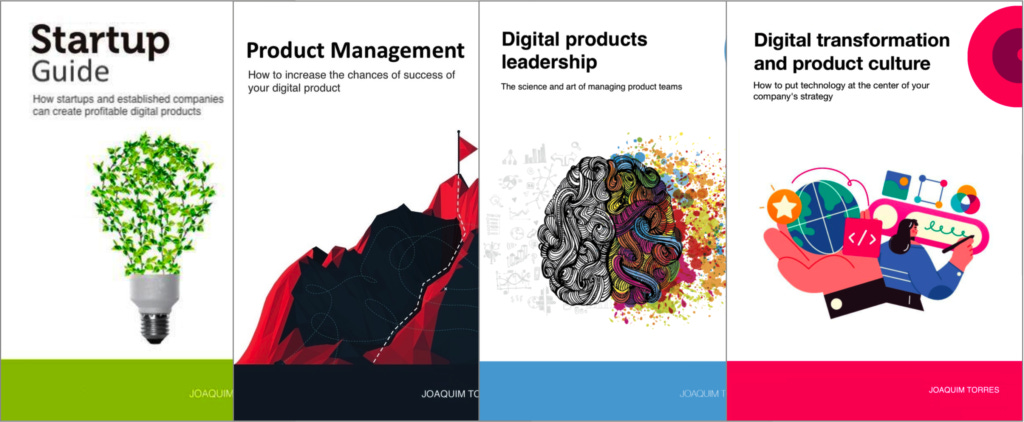
Digital transformation and product culture: How to put technology at the center of your company’s strategy
Leading Product Development: The art and science of managing product teams
Product Management: How to increase the chances of success of your digital product
Startup Guide: How startups and established companies can create profitable digital products